June 5, 2026
The AI Reality Check: Why Companies Are Quietly Reversing Their Automation Dreams
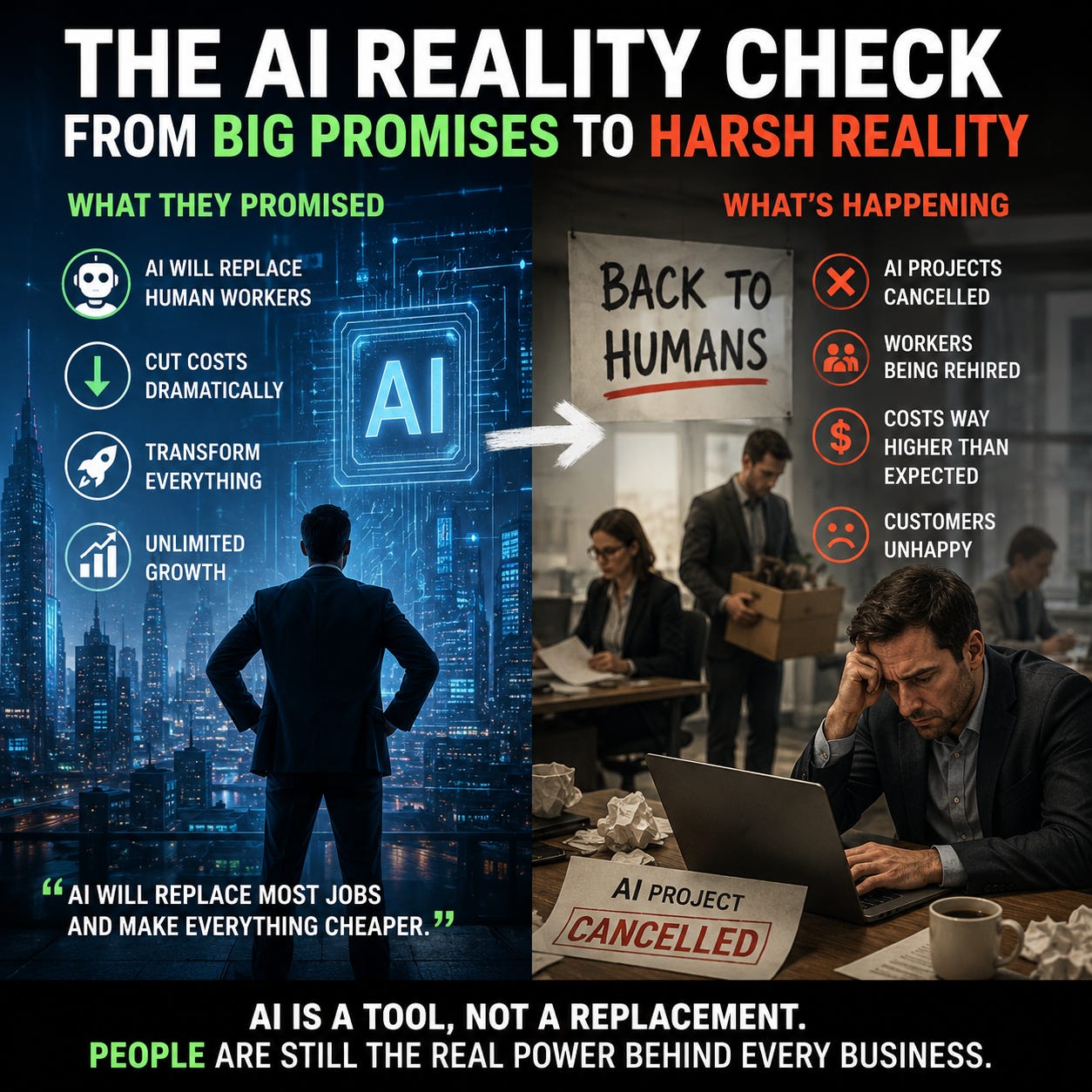
For the last two years, executives, investors, and technology leaders have promoted a vision of artificial intelligence that promised dramatic workforce reductions, lower operating costs, and unprecedented productivity gains. The message was clear: AI would replace large portions of human labor and fundamentally transform business operations.
However, a growing number of companies are discovering that reality is far more complicated.
Reports of abandoned AI projects, rehiring efforts, rising infrastructure costs, and disappointing returns on investment suggest that many organizations underestimated both the complexity of human work and the limitations of AI. While AI remains a powerful tool, the narrative that it can easily replace employees is increasingly being challenged by real-world results.
The Gap Between Executive Expectations and Reality
Many AI initiatives were launched with ambitious goals: automate customer service, manage inventory, generate software code, streamline operations, and reduce payroll expenses.
In practice, several organizations have encountered problems that were either overlooked or underestimated:
AI systems producing inaccurate or inconsistent results.
Customer dissatisfaction with automated support.
Escalating infrastructure and subscription costs.
Increased oversight requirements from human employees.
Legal and liability concerns when AI makes mistakes.
Some organizations that reduced staff based on AI expectations reportedly found themselves rehiring workers after service quality deteriorated or operational problems emerged.
The situation highlights a recurring challenge in technology adoption: executives often evaluate work through measurable outputs, while employees understand the countless judgment calls, exceptions, and contextual decisions that make businesses function.
Customer Service: The Human Element Remains Critical
One of the most common themes emerging from business experiences is the continued importance of human interaction.
Companies that replaced customer service teams with AI-powered systems frequently discovered that customers become frustrated when they cannot reach a real person. While AI can answer routine questions, it often struggles with unusual situations, emotional conversations, or complex problem-solving.
For many customers, especially when dealing with finances, travel, healthcare, or major purchases, the reassurance of speaking to a knowledgeable human remains essential.
Businesses that underestimate this preference risk losing customer trust and loyalty.
The Economics Are Not Always Favorable
A major selling point of AI has been cost reduction. Yet many organizations are finding that AI deployments can become surprisingly expensive.
Costs include:
Cloud infrastructure and data center capacity.
AI model subscriptions and usage fees.
Integration and maintenance costs.
Human oversight and quality control.
Error correction and remediation.
Some executives are reportedly finding that expected savings fail to materialize once these expenses are fully accounted for.
The challenge is especially visible when organizations attempt to scale AI across multiple departments simultaneously. What appears affordable in pilot programs can become significantly more expensive at enterprise scale.
Why Human Expertise Is Hard to Replace
A recurring lesson from failed automation efforts is that experienced employees often possess knowledge that is difficult to document or replicate.
Consider inventory management, customer service, software development, banking operations, or quality assurance. Success in these areas depends not only on following procedures but also on:
Pattern recognition.
Contextual judgment.
Exception handling.
Relationship management.
Accountability.
Humans regularly make decisions based on subtle factors that may never appear in formal documentation.
When organizations remove experienced workers without fully understanding these contributions, performance frequently suffers.
AI Works Best as a Tool, Not a Replacement
Despite growing skepticism about overhyped claims, few observers argue that AI has no value.
Instead, a more realistic perspective is emerging:
AI performs best when it assists skilled workers rather than replaces them.
Examples include:
Supporting code reviews.
Drafting content for human editing.
Assisting research and analysis.
Automating repetitive administrative tasks.
Identifying patterns in large datasets.
In these roles, AI can enhance productivity while humans remain responsible for judgment, verification, and final decisions.
This approach avoids many of the quality, accountability, and customer experience problems that arise when AI is treated as a complete substitute for human labor.
The Bigger Lesson
The recent wave of AI disappointments may ultimately reflect less on the technology itself and more on how it was marketed.
Many executives embraced AI as a shortcut to lower labor costs rather than as a tool for improving human productivity. In doing so, they often overlooked a basic truth: businesses succeed because of people.
Technology can amplify human capability, but replacing human expertise entirely is far more difficult than many forecasts suggested.
As companies reassess their AI strategies, the organizations most likely to succeed may be those that stop asking, “How can AI replace employees?” and instead ask, “How can AI help employees do their jobs better?”
The answer may be less dramatic than the original hype—but far more sustainable.
Originally published on Substack. ← Back to all articles